News & Press: Press

Huffington Post: ‘A True Artist’: How The Unstoppable Michaela Coel Became The Most Exciting Talent In TV – By Those Who Know Her

17.08.2020 | Press

By Adam Bloodworth

“She’s there as a colleague, as a mate, and then she’s there jumping into the role of actor for a scene,” reflects Ita O’Brien, intimacy coordinator who worked with Michaela Coel on I May Destroy You. “And on days where she’s finished her scene she’s into her own clothes and bang, into co-director mode… And then, ‘oh sorry, I can’t have this conversation, I’ve got to go and have a production meeting’: into executive producer mode.”

This is only the briefest glimpse into what life was like for Michaela Coel during the shoot for I May Destroy You, the BBC drama which set a new precedent for how consent and sexual assault – moreover, just how lives in general – can be authentically portrayed on screen. 

Soon after, when Coel appeared on the front page of New York Magazine captioned ‘Michaela The Destroyer,’ her small but robust international fanbase felt validated. I May Destroy You has seen Coel rise to a level of fame and prominence only those closest to her could have quietly predicted. Not that anyone would have listened. 

“What’s brilliant about her is she’s calling the industry out: going ‘hold on a minute, you’re not really considering us,’” continues O’Brien of Coel. “I do feel it is groundbreaking. How Michaela writes, what she has written about, and also the fact that she’s a woman writer.

Take the scene in episode three of I May Destroy You (mild spoiler alert) where Coel’s character Arabella is hooking up with an Italian man named Biagio, who notices a blood clot in her period discharge during sex.

“The paraphernalia of a menstruation isn’t something that’s out there,” says O’Brien, who notes that half the population spend roughly half their lives engaged in a menstrual cycle, yet when has the reality of that been shown on TV before Coel?

“It’s so gratifying being part of something that is helping people have that awareness,” continues O’Brien. “Plus, when else have you seen a woman of colour with an Asian man?”

Creative Review: How I Work: Intimacy Coordinator Ita O’Brien

12.08.2020 | Press

head and shoulders portrait
Ita O’Brien. Photo by Nick Dawkes

By Rebecca Fulleylove

Intimacy Coordinator Ita O’Brien has worked on TV shows including Sex Education, Normal People and I May Destroy You to help actors feel empowered in intimate scenes on screen. She talks about her work and why brands and advertisers need to take notice of it too.

Ita O’Brien is an intimacy coordinator and movement director for film, television and theatre. Previously a dancer and actor herself, she’s channelled this experience into creating safe, considered and consensual environments when it comes to working with intimacy, and in scenes with sexual content and nudity in film, TV and theatre. 

O’Brien has pioneered the role of intimacy coordinator and she has spent the last six years developing the Intimacy on Set Guidelines, a best practice document that covers everything from the audition process to when the actors are on set. She also founded Intimacy on Set, a service that provides intimacy coordinators, consultancy, advocacy and training for TV, film and theatre sets.  

The role of an intimacy coordinator has been put in the spotlight more recently because of O’Brien’s groundbreaking work on smash hit TV shows including Sex Education, Normal People and I May Destroy You, all of which tackle sensitive subjects around sex, intimacy and relationships. The beauty in O’Brien’s work is her ability to lay out best practice processes to ensure all parties feel safe and protected, all the while ensuring these intimate portrayals still feel authentic, engaging and a key part of the storytelling.

Here, O’Brien explains what the role of an intimacy coordinator actually involves, the challenges she’s faced and why anyone involved in portraying sex or relationships to the masses has a responsibility to do it from a position of “equality, safety and care”.

The Cut: How to Build A Sex Scene

30.07.2020 | Press

Photo: Dean Sewell/The New York Times/Redux

By Sangeeta Singh-Kurtz

Between Normal People and I May Destroy You, we get good sex, bad sex, and everything in between, with the latter focusing on sexual assault and non-consent. Ostensibly, these two shows are very different outside of this emphasis on intimate content, which is perhaps why they also find common ground in a shared production member: British intimacy coordinator Ita O’Brien.

Intimacy coordinators play a new role in the entertainment industry; as the name implies, they oversee and help direct intimate scenes. When used correctly, they’re brought in early in the filmmaking process, while the scene in question is still on the storyboard. O’Brien describes her job as akin to the stunt coordinators’, which, if you’ve ever watched a Fast & Furious film, is requisite. “They listen to the director, read the script, find out what the storytelling is for that stunt, what the risks are and then teach their actors or stunt doubles techniques in order to make that stunt safe. They put in place things like crash mats and then choreograph the whole thing really clearly,” she said when we spoke over Zoom last week. “Just as a stunt coordinator does, we’re putting in our ‘crash mats.’”

Hiring an on-set intimacy coordinator became more common in the wake of the Me Too movement, but O’Brien had been working closely on sex scenes for years before. She used to work as a movement director — she created a set of guidelines and best practices around scenes with sex and nudity in 2014 — and in 2017, she was hired in that specific capacity for the first time.

The Cut spoke with O’Brien about her job, the film industry’s relationship to intimate content today, and how she built sex scenes for two shows that explore completely different kinds of intimate encounters.

Directors Notes: How Lenny Abrahamson Transformed Sally Rooney’s Best Selling Novel Into the Record-Breaking TV Event of the Year

27.07.2020 | Press

Normal People

Another great strength of the series is that the sex feels authentic and engaging but not at all exploitative. You were initially concerned that working with an intimacy coordinator might be a barrier between you and the actors, how did that role integrate into and assist the production?

Yeah, I was concerned about that. I had never heard of that role so I thought, what is this and are we sure we need it? There have been great sex scenes shot in the history of film, we do lots of difficult things so do we really need a special role there. But actually, when I met Ita O’Brien my feelings changed. What she’s trying to do is to take away all of this fumbly embarrassing conversation and provide a really open forum where you can all talk like grown ups. What are the images that we’re trying to create and how do we go about doing it involving everybody in a way that makes them feel heard. Ita’s very practical as well. She has all these garments and padding and she’s very good at devising how to support the actors’ body weight in ways that make it look like they’re in insanely close proximity but in reality not so much. She also provides a forum for us to talk. For example, for me to be able to say, “Oh I think this would be good”, without the actors feeling any pressure to say, “Oh yes of course. I’d love to do that.”

If you’re an established filmmaker, it’s understandable if young actors feel like they want to please and say “yes of course”, and do something because I think it’s right, not because they feel right about it. It would make me anxious to ask if I felt they were going to say yes just because they didn’t want to disappoint me. Ita’s brilliant, she has a way of talking about this stuff which makes it really clear to the actors that they are central to this and that we’re all working in a collegiate way around what they’re comfortable with. And so I never felt that there was ever any pressure which was a great thing to be able to know.

Did Ita’s presence and the back and forth between the four of you lead to the restaging of any of the planned sex scenes?

Well I tend to be pretty flexible, at least around script anyway, so I move things to different locations, I change dialogue. I do all sorts of things all the way through production including on the day. So actually that fitted with me really well because Ita would suggest that something might fit better with the meaning of the scene as she’s very involved in discussing character as well. We talked about every intimate scene in advance and if it ever felt like, it would be better to do this here or this doesn’t feel like a scene that should happen in this way as written let’s do it that way, we would always make that change.

Who What Where: Unraveling Fashion, Beauty, and Trauma in I May Destroy You

20.07.2020 | Press

I May Destroy You. Photo courtesy of HBO

BY DREW ELOVITZ

Not only was the BBC happy for Coel to write the entire series, but it also wanted her to star in it, direct it, executive-produce it, and maintain ownership rights over the original content. “This was a dream. … They really gave me what I needed, which is still quite hard to fathom,” she says, smiling. In addition to having more agency behind the camera, Coel advocated for both a full-time therapist on retainer for cast and crew members as well as an intimacy director, Ita O’Brien, to create a safe and supportive atmosphere on set.

I noticed O’Brien’s name in the credits, prompting me to ask Coel if she had ever worked with an intimacy director before. She hadn’t, and neither had Weruche Opia, the actress who plays Terry, Arabella’s best friend. “I’ve seen how complex things can get when you don’t have an intimacy director,” Coel explains. After first learning about O’Brien from an article in The Guardian, both Coel and her co–executive producer, Phil Clarke, felt that this off-screen role would be an essential element of the show, particularly given its subject matter. “It’s not just sexual intimacy,” Coel explains, “Some of it is sex without consent.” 

O’Brien, who also worked on Hulu’s Normal People, played a significant part in empowering actors on set. This included Opia, who opted to use a body double for her character’s sex scene. “[O’Brien] was very inclusive,” recalls Opia in a separate Zoom interview. “She showed me what Terry would be doing as my character and made sure I was comfortable with what was being shown. I felt respected, and I felt heard,” Opia affirms, concluding, “I think it’s essential in filming scenes that are so intimate and vulnerable. I think it’s a brilliant idea and should be an industry standard.” Coel concurs, noting that it was important to her to create an environment in which her colleagues were supported. “You may be empowered [by O’Brien] to do the scene, but you’re also empowered to say I don’t actually want to do this,” she explains. “I love the fact that [Opia] felt she could express that. … To have that happen was incredible.”

Tyla: Why The Period Scene In ‘I May Destroy You’ Was So Important

17.07.2020 | Press

Credit: BBC

By JOANNA FREEDMAN

Creating a scene so viscerally relatable to half of the UK’s population, and showing it authentically, is no mean feat.

Of course, it’s down to Michaela’s writing, first and foremost; then there’s the props department, the actors and the production team. But the one woman tying all of those departments together was the show’s intimacy co-ordinator, Ita O’Brien.

Intimacy co-ordinators are a pretty new phenomenon, only emerging in TV and film in the wake of #MeToo, with a long way to go before their use is standardised.

But their work couldn’t be more essential; not only ensuring the safety and wellbeing of the actors, but choreographing the sex scenes down to every fine detail, and ensuring that every tryst looks as real and honest as possible on screen.

During the creation of I May Destroy You, Ita worked with the cast in rehearsals where they’d discuss each scene moment by moment, ensuring “every touch had intention”.

And, as she tells Tyla, it’s for this exact reason that scenes like the period sex ring so true.

Read more…

SYFY: Brave New World showrunner: Aldous Huxley ‘wouldn’t be very surprised’ by the changes

17.07.2020 | Press

film still
Credit: Peacock

BY JAMES GREBEY

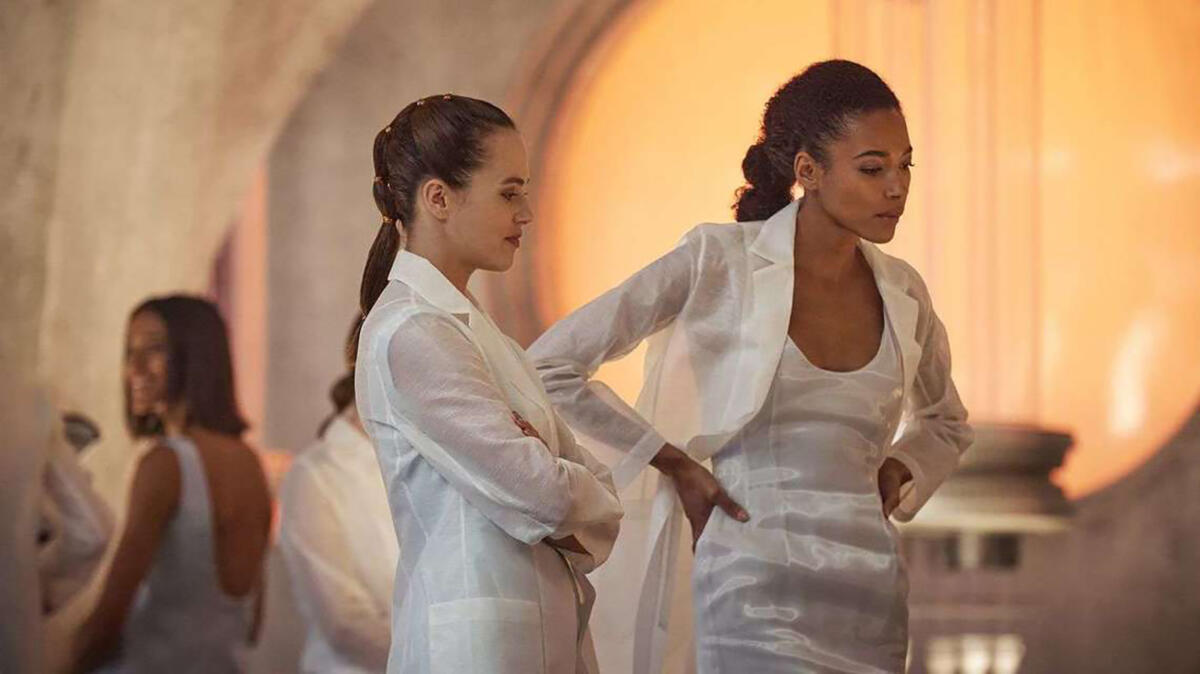
One thing that didn’t change from the book? The sex. New London is a promiscuous society, something that Wiener says was always going to be part of the show, even when it was being developed for network TV rather than Peacock, which, as a streaming service, can show more than viewers might otherwise see while channel-surfing.

“I think [executives] realized there was no way to adequately serve the idea of New London without being able to show how New Londoners achieve pleasure and how they spend their time and how their attitudes in terms of modesty and sexuality are different than us,” Wiener says. But, in perhaps another way of showing how our culture has evolved, behind-the-scenes, he stresses that the series’ intimacy coordinator, Ita O’Brien, was essential to bringing New London to the screen safely, respectfully, and consensually.

“She empowered everybody and everyone felt really secure, and it kind of demystified [the sex and nude scenes] in a way that allowed everybody to kind of be free in the way that New Londoners would be,” Wiener says, also complimenting his actors for being “brave enough to go there.”

All of this results in a version of Brave New World that feels both of-the-moment and indebted to its trailblazing, nearly century-old book. And, before you ask, Wiener is aware of the irony that, ultimately, Brave New World, a work about a populace who have been made complacent with titillating pleasure and entertainment, is now yet another new series on yet another streaming service. 

“We don’t expect that irony to be lost on the audience either,” Wiener says with a laugh. He actually leaned into it. The fake commercials for The Savage Lands and new varieties of Soma were intended to blend seamlessly with real commercials, back when Brave New World was being developed for ad-supported TV. 

“On some level, we are part of what Huxley was concerned about,” Wiener says. “At the same time, I hope ultimately that awareness and that intentional irony allows people to ask the questions that I think Huxley would want them to ask.”

TV Insider: ‘Brave New World’ Takes a Dark Turn

17.07.2020 | Press

film still
NBC Peacock

By Martin Holmes

Let’s start with that sex scene, shall we? Actually, let’s talk about Brave New World’s obsession with sex, nudity, and orgies in general. Do they serve a thematic purpose or are they merely cheap titillation? Honestly, it’s probably a bit of both. But it’s not as if any of this is widely off-book from Aldous Huxley’s version, which was full of frivolous fornication. What should be noted is how the show worked with intimacy coordinators Ita O’Brien (who also consulted on I May Destroy You and Normal People) and Kate Lush. I think this goes a long way in giving the actors agency in scenes which can be rather exposing and uncomfortable.

“Kate and Ita gave our actors such confidence, command and ownership of the experience of being vulnerable,” showrunner David Weiner told Drama Quarterly. “You’re exposed, and they just embraced it.” You can definitely tell how much it helped with Lenina’s (Jessica Brown Findlay) sex scenes. Lenina’s character remains present in these vulnerable moments. She’s not just a naked body thrown in for the raunchy thrill of it all. You’re still emotionally connected to her and her reactions to what is happening in the moment.

Vogue: ‘I May Destroy You’ Star Weruche Opia Is Nobody’s Sidekick

16.07.2020 | Press

BBC

BY HAYLEY MAITLAND

One area in which Coel went out of her way to make Opia feel safe? The scene in which Terry has a threesome while visiting Arabella in Ostia, Italy. Opia planned to turn down the role – her dream part – if any form of nudity was required. Under other circumstances, that might have lost her the job. On a set run by Coel, it meant that Opia was not only provided with a body double, but that the programme’s intimacy coordinator, Ita O’Brien, kept Opia abreast of the plans for every shot to make sure that she felt happy with the way the scene would appear on film.

Notably, Coel also had dedicated counsellors on hand throughout filming in case either talent or crew members struggled with the more graphic material – and it’s no accident that Terry’s decision to institute a veritable self-care regime for Arabella post-assault is a major plot point in the series. “It’s definitely becoming clearer right now what a vacuum there is in terms of support for Black mental health,” Opia says, nodding to the experiences of the Black community following the death of George Floyd. “As a generation, we’re more conscious of how important mental health really is – not just in terms of what’s happening in our own lives, but in terms of the residual effects of the past as well. We’re only just starting to realise how much we’ve internalised the mistreatment of Black people from so far back.”

Stylecaster: How Shows Like ‘Normal People’ Are Normalizing Consent

16.07.2020 | Press

film still of actors in intimate embrace
IMAGE: HULU. DESIGN: CIERRA MILLER/STYLECASTER

BY EMILY BELFIORE

Part of the reason why Edgar-Jones and Mescal were able to portray this level of affection with such accuracy was because the actors had worked with intimacy coordinator Ita O’Brien when choreographing each sex scene. To create a climate on set where both actors felt comfortable and safe, O’Brien constantly checked in with them to receive their consent before proceeding with the directions for the scene, which further contributed to Edgar-Jones and Mescal’s palpable onscreen chemistry. 

In fact, in an interview with Vanity Fair, O’Brien said that Normal People directors Lenny Abrahamson and Hettie Macdonald’s approach to sex scenes had changed considerably in response to the #MeToo movement, noting, “With #MeToo and Time’s Up, and all the industry going, ‘We have to do better,’ and then suddenly the codes of conduct are going, ‘We can no longer as an industry tolerate abusive predatory behavior.’

Contact us